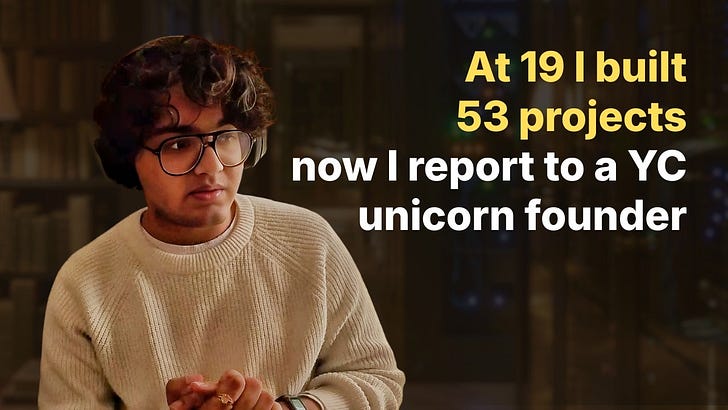
Kuber just turned 19 and works on foundational models on the central AI team at Razorpay, one of the biggest fintech in India, and the first Indian company YC has ever invested in. He directly reports to Harshil Mathur, its CEO.
Before this, he had built 53 projects, spanning from a fly brain simulation learning English to a native macOS driver for a printer HP never supported, which hit 3.5M views.
Before that, he almost went to culinary school at 17 because he was bad at math.
He writes MindDump, a blog read with 100,000 visits a month.
Today we sit together to talk about his journey and all things building.
I tell these stories because I think the distance between you and the person in them is smaller than it looks, and the only way to prove that is to show the whole path instead of the endpoint.
Watch on Youtube, listen on Apple Podcast or Spotify.
Timestamps
(00:00:00) - How he almost ended up in culinary school instead of computer science
(00:03:02) - Building, obsession, and why he still went to university
(00:10:43) - Nobody around him builds, so he found them on Twitter and Discord, and how to start posting at 16
(00:17:33) - LinkedIn vs X, and what each platform is actually for
(00:20:13) - 40 projects, and how to start building at 17 with no background
(00:27:48) - Building for money vs building to make something
(00:33:51) - Urgency, ambition, and comparing yourself to people further ahead
(00:38:31) - What school does not teach, and building cultural infrastructure instead
(00:43:22) - The blog, writing to think, and 80,000 readers a month
We need more stories.
If you’re under 21 and you’re building cool things in whatever disciplines (or know somebody who does) I’d love to tell your story; reach out to brando@illegible.world.
Find Kuber
Find Brando
Find Illegible
Friends of Illegible
Martin van der Heijden is a friend and early angel investor. I’ve worked with him as a software engineer intern, and he deeply cares about the success of other people. He currently hosts unusually good events and experiences for remarkable people at Jack & Jill, you should check out his work.
Transcript
00:00:00 - How he almost ended up in culinary school instead of computer science
Brando
Thanks a lot for joining me. You’re a founder, a builder, a writer, a gamer, but somehow you’re also still like a computer science student and you’re like 18 or 19. Is that right? Yeah.
Kuber Mehta
I mean, I try to balance it, but yeah, I mean, quite flattering. Thank you.
Brando
The way that I would like to start this interview is by bringing up a fun fact, which is you almost went to culinary school, I guess, one year ago or two years ago, but then you actually went for computer science. Can you tell me a little bit about how that decision or not decision took place?
Kuber Mehta
Yeah, it’s actually quite a fun story. So in India, to get into a good engineering school, you have to give a pretty difficult exam called the JEE Advanced. It’s, I think, one of the hardest exams in the world for undergrads. And yeah, I had to go through that process. I spent 11th and 12th grade just studying for that. I didn’t go to school. I just studied for it. We have this entire culture of doing that.
And I sucked at math pretty much. And those two years were some of the most depressing years of my entire life. I had been building since I was very, very young. But since I sucked at a couple of things, it was like a really, really weird place in my life. And then my parents, like, suggested that, hey, like, you’re probably not cut out for CS and your teachers are saying the same.
You’re probably not going to get into that grade of university. So why don’t you just go to culinary school, like, you cook well? And at that point of time, when you’re that messed up internally, you start to actually weigh your options. And yeah, I just gave the interview. I think it was like a couple of days before the deadline. And yeah, I just got in. I had my bags packed. We went to the university and we were like, okay, well, this is the future.
And that’s exactly what I’m going to do. But I just had this random snap of realization, like, what the actual, like, am I doing in my life, right? And yeah, I started to, like, look back through my entire life, what I’ve always wanted, what my passions are. And I just found out that maybe I don’t even care if I go to university. If all that matters is building, I can build on my own.
Does not matter where I go. Does not matter who I am with. Frick college. Like, even if I don’t go to college, I’m just going to learn. I’m going to become the top 1% of anything I pick up. And I’m just going to do well in my life. So I was like, I’m not going. I had, like, the deposit paid and stuff too. We had to get a refund after. So I got into another university for AI and it’s not that prestigious comparatively.
But yeah, I just studied my ass off. I made random ass projects for the last year and I’ve been quite happy. I’m glad it worked out.
00:03:02 - Building, obsession, and why he still went to university
Brando
That’s a beautiful story, man. Can you please elaborate on the concept of, you said, the most important thing to me is to build. What’s the definition of building and how did you come up? I mean, how did you arrive at that conclusion? Because I think that the term building, it is something that has become trending in the last couple of years. But for instance, when I went to university, it wasn’t like a term that we used to say.
Yeah.
Kuber Mehta
I say this quite often. I grew up with the internet. I had internet access when I was 8 years old. So I’ve seen the entire Silicon Valley, the online, you know, the entire following. I’ve seen it unfold in real time. And I started programming when I was 12. The thing I realized quite early on is the only way you learn something practically better than any textbook or any teacher will teach you is by doing things and messing up.
The more you do that, the more you iterate, the more you learn. And just that concept. I mean, it wasn’t called building, like you said earlier. But I think most people are familiar with that. But most people don’t have the initiative to do that. So if you, like, put in your heart, put in your entire being of trying to perfect something you’re obsessed with, I think obsession is the word. That’s when you realize that, hey, maybe it’s just building cool things.
Brando
Beautiful. And I want you to elaborate more on the concept of obsession. Because, like, in my opinion, and maybe you have a different one, I think that people misread the word obsession. And because they think that they have to be, as in, by definition, obsessed with the thing. But, like, maybe they think about it in, like, an extreme way. So they never start because they are like, well, I can totally live without this thing.
And, therefore, I’m not obsessed. And, therefore, I will not start it. And I will wait for something that I am, quote, unquote, truly obsessed to start with. But based on your portfolio, and we will talk about it later, like, you built, like, something around 40-plus projects. I guess that we need to give more nuance about the term obsessed. Because so many of the projects you built, they’re beautiful. But then you passed to the next one.
So can you please give us a bit of context on the word obsession in your terms?
Kuber Mehta
I think obsession, in general, is a term which is seen rather negatively in most other circles. But I think obsession is anything you can do all day and not get tired. You know, I have a friend that customizes Labubus for a living. And she sells them on eBay. And she’s doing extremely well. And, you know, you could say that she’s obsessed with making Labubus. Like, who isn’t? If you’re, like, really, really good at sleeping, you’re, like, so good that you get, like, a 100 Whoop score every single day.
You could capitalize off of it. And that’s your obsession. Anything that makes you happy and that you can survive with and potentially make money with, I think is a good obsession to have. And that, for me, was just experimenting with AI tools. Like, finding that is a lot of trial and error. I made Roblox games for three or four years of my life. I freelanced for other people. But I realized, like, quite deep in that maybe that’s not the right obsession to have.
You do feel that. And I think it’s very important to try to iterate and find new things that you might really like. And then when you do find something that is, like, really, really good and makes you happy, that’s the best obsession to go after. And you can maybe spend entire weeks, months, years, working on that, and you stay actually content. That’s the true obsession you’re going for.
Brando
Is there a thing that you have been obsessed with, let’s say, even for either, like, a month or, like, seven months? And then after a while, you were just like, okay,
Kuber Mehta
I’m done with this. Let me just do something else. Yeah. I was quite deep into art. And I was quite deep into pixel art for a while. I even made a couple of games related to it. But I think there are some things which require so much patience and some things which are, like, extremely seasoned industries. That takes a lot of effort and a way higher level of obsession to get into.
So that, and I think another good example would actually be culinary, because it’s such a passion-driven industry. Like, people spend 12 to 14 hours in the kitchen just making, like, food for other people to try. And they’re, like, actually content when other people taste their dishes. That’s such a passion-driven industry. So, yeah, I think there are a lot of things that are that way.
Brando
Yeah. I love the example of the culinary art, because I’ve been to India, and I know many Indian people, and the food there is just, like, insane. And it is also, like, quite complex. Like, even if you take something, say, considered simple from the outside, which is, like, a biryani, there is, like, actually, like, a couple of hours of preparation behind it, and people don’t know about it. Let’s go back to your journey, because, like, one of the things that I was very curious to ask you about is, so you’ve been coding since you were 12.
You also became a Roblox millionaire
Kuber Mehta
at 14. Yeah.
Brando
But you, and pretty much, like, you know how to build and everything. So, why did you still decide to go to university? Like, why is that useful to you, either personally or from a career point of view? And now that you’ve been in university for the last, I guess, 12, 18 months. Yeah. Would you still have gone to university if you could go back?
Kuber Mehta
That’s such a good question. And I have, like, my constant internal battles about the same thing. One thing I was quite clear about early on was that anything that my university does teach me is not going to be that useful in the real world. And you do realize that quite early if you’re in the tech scene. So, I specifically picked my degrees. I’m actually doing two degrees so that I don’t have a lot of time commitment going in.
So, one of them is quite lenient with attendance, and the other one’s online. So, I’m, like, able to actually cook and make things. But I think there’s a traditional sense of security, especially for my parents, that I’m going to a real place. And I think the other thing that universities do provide you is the constant social circle. People around your age who are doing things that, you know, people around your age should.
I think that’s something which is quite important, and that does get missed out in these scenes. The only other alternative, I think, of leaving university is if you get into a program or a hacker house. Like, you went through EF, so I’m quite sure you actually get a feel for how people are, like, in that way. But if you’re in some place like that, I guess it makes sense to go all in and do that.
But other than that, being an entrepreneur or being a founder is pretty isolating, especially if you don’t have a co-founder. So I think having some sort of a social fallback is extremely important at that sort of age.
Brando
Do you, this sort of fallback, I guess there are, like, two sides of it,
00:10:43 - Nobody around him builds, so he found them on Twitter and Discord, and how to start posting at 16
Kuber Mehta
from one side, the pure social aspect of it. Like, you want to be surrounded by people that you like and that you love and they give you love back. And at the same time, you also want to be surrounded by people that you are very aligned with in terms of passions and career and, let’s say, other people that you can build with.
Brando
In your experience, are you surrounded by both kinds of people in terms of, you’re surrounded by both friends and also friends who like to do the things that you like? And if so, how did you find these people around the university? Like, is it common for Indians to be able to build like you do or do you need to find your niche?
Kuber Mehta
I’ll say this very frankly, it’s extremely uncommon. And with me especially, I do not find people around me that are building that way. Most people do not have the initiative or the drive to find something they are truly obsessed with and go after it. And I think having that craft is something which is innately quite rare. What is really important, though, is that you actually find them any way possible. For me, it’s mostly online.
I have quite a few friends on Twitter and LinkedIn and some I found through Discord or some through other means that do build that way. But finding them offline and like in person is the end goal. Like the residencies I’ve gone to, they are some of the most locked in, some of the most passionate people I’ve ever met. And if you have some sort of network like that in your day-to-day, that’s going to be like life-changing completely because, you know, they say you’re the average of the six people you surround yourself with.
If those six people are just as passionate about building anything, you’re going to be a different person. All in all.
Brando
100%. I guess that’s like the second step. Like, I think it’s way harder to find people physically, as you said. And maybe something that people can start with, if they are like 16, 17, 18, 20, is to go through the route of Twitter and Discord and everything. Let’s go. So you post a lot, both on LinkedIn and on Twitter. And I love everything that you post. And, like, I think that one of your Indigo airplane company things went viral the other day.
So that was really fun. Can you give a two-minute crash course to your 16-year-old self about how to use Twitter and why to use Twitter? Because, like, at least in Europe, if you’re, like, under 21, you don’t really use Twitter. But it’s such, like, an important tool. So, yeah. Little crash course, please.
Kuber Mehta
Yeah. I post a lot because I’m just as curious about how social media and algorithms work. Social media and, in general, algorithms are a people game. If it is good for people, if it impresses people, if it gets the attention, it’s pushed higher. If it doesn’t, if it sucks in any way, any optimization, it’s not pushed. And if you do master social media algorithms, you master how people’s attention works. And that helps you in every single aspect of life.
So the first thing, which is quite controversial, is have a tone of your own. You know, people on LinkedIn, especially, like, extremely professional people, always have this opinion of, hey, this is a professional platform. You need to maintain the tone. But the people that do the best and the people you instantly recognize are the people who are innately different. I met this guy back in Dubai and I remember him only from the fact that he said crazy instead of crazy.
He said that so often that it became a staple. And every single time I hear the word crazy, I remember him in my head. You need that sort of tone or that sort of one personal thing that sets you apart. That is extremely important. Second thing is just post your mind. Do not overthink it. You learn from actually doing things in any single industry, in whatever you’re doing in life. So you need to FAFO, right?
And posting like that is probably the most low friction way you can learn to do that. Post multiple times a week, maybe every single day if you’re up for it. But I think the only way you can learn and the only way my 16-year-old self could learn or a 21-year-old guy, like in the future with a different algorithm, just post every single day, find people that are in your niche, study what they do, and try to improve whatever you’re doing by 1-5% every single day.
Improve the formatting, try different thumbnails, try different images, right? And the most important thing is have fun with it, you know. At the end of the day, you’re learning something. And if you’re not actually having fun in the process, it doesn’t make sense. Like even if you go viral, you won’t have that dopamine rush again, right? So you need to actually be fulfilled and have fun with whatever you’re doing. That’s it.
Brando
Awesome. Yeah, just for context for anybody who will listen to this, I think that’s, I mean, you said at a certain point, post a couple of times per week. But in reality, I think that you post at times even like 10 times a day, and you do
Kuber Mehta
this like across LinkedIn and Twitter, which is very fun. I do that sometimes as well. And it’s just entertaining. And actually, people can relate with,
Brando
yeah, if you just like write and publish in the same way that you talk in real life, people, they’re just going to see your authenticity behind it,
Kuber Mehta
even if it’s just like one person. Yeah, I’m going to add a little bit more. In social media, you can have two techniques of doing well, right? You can either be a machine gun or you can be a sniper rifle. So a machine gun shoots multiple times and maybe one or two of those hit and you’ll accomplish your goal. A sniper rifle hits once and it’s incredibly precise and it’ll like accomplish the goal in the same way.
At the start, it’s very important that you do the machine gun aspect because you learn every single day from every single post. But after that, if you actually understand everything enough and if you think you’re actually confident enough, the sniper rifle way is the better one in general. But yeah, I post multiple times a day because I just post my thoughts and I try to do a little optimization and check what works, what time works.
There are a lot of factors into it. But when you actually start doing that, you’ll start to realize it as well on your own.
00:17:33 - LinkedIn vs X, and what each platform is actually for
Brando
Are there any differences that you have noticed in your experience between LinkedIn and Twitter? Like do you use them differently or do you just like copy paste one thought and you just put it on the other
Kuber Mehta
platform? That won’t work at all because they are fundamentally different platforms in general. On LinkedIn, you have to account for the general audience more. Like when I’m trying to explain something technical, I have to break it down in a way that a five-year-old can understand it and someone who’s very, very deep and specializing in that minor thing also understands it well. So every single thing, also my blogs, I try to format in a way where everybody gets a takeaway from it no matter where you are in life.
On X, especially in tpot, like the technical side, you don’t have to explain it as such. And if you like try to explain what a transformer is, people are going to be like, who is this guy? Why is he telling us basic things? Right. So you have to account for the audience you’re posting for. And that audience is innately different for LinkedIn and X. And like there isn’t a rule of thumb.
You have to understand your own audience. Nothing I can say here directly transfers to you. So you have to experiment a lot. You have to find out what other people in your network are talking about and try to format it in the same way. But if I post something on LinkedIn, I can’t post the same thing on X because it’s like very, very different in terms of the people and how they think and how they actually use the platform.
Brando
Super clear. Besides posting, how do you use both platforms if there is another use besides posting? Like, do you reach out to people? Do you or do you just wait for others to reach out to you?
Kuber Mehta
How does it work? That’s a cool question. And I think it quite differs for every single person. For me personally, I’m not actively looking to reach out to a person unless it’s something very specific for like programs and cool new things or X is much faster. And even the news, you get that in like minutes, if not a couple of hours, on X. LinkedIn is much slower comparatively, but it has much more of a professional network.
Like if you’re trying to find a certain person from a certain company, you find that on LinkedIn. So say if you’re a founder, if you need more B2B leads, that’s more LinkedIn. And if you’re looking for more technical people that will use your product day to day, if it’s something like a developer product, that’s more of X. So it differs what you actually are and what you want to accomplish on the platform.
00:20:13 - 40 projects, and how to start building at 17 with no background
Brando
Let’s go back to your projects because so you’ve built and you can find these projects on your website.
Kuber Mehta
And there are
Brando
like 40 of them. Some of them are quote unquote, let’s say, more simple.
Kuber Mehta
But other
Brando
ones are, let’s say, somehow more complex or, let’s say, a hybrid between the two. So I was impressed by this because, I mean, 40 projects is a lot. And I think that the moment you start to code or any way to build, the first thing that you learn on YouTube channels is like, you got to build your own projects. And so can you give us a bit of context on how you come up with ideas for your projects?
And what are you trying to achieve with your projects? Is it just like for pure fun? Is it for money? Is it for career building? Like what happens in your head when you start to think about building something?
Kuber Mehta
Yeah, that’s a great question. I think there are two main aspects to it. First of all is identifying a problem and finding a fix. That’s how most companies work. That’s how startups work in general. And if you do find something in your day-to-day life that’s not automated enough and that’s not, you know, covered for well enough in the technical space, you can actually just build things. And when that hit me, I just started finding so many things every single day.
Like when I went for a shower, I would randomly think like, hey, this website does not do this thing well enough. I’ll just note it down on my Notion list. And I have like a hundred ideas on my Notion. I kid you not. I get like three to four ideas every single day. I don’t have time to build out all of those. And the other one is the virality aspect. Some ideas are so embedded in the meme culture and are so shareable in one way or another that when you do post that, they are bound to do extremely well.
So I had this idea of fitting Doom inside of a QR code. It’s innately memeable. And it’s obviously quite technical because you’re actually fitting games inside of a QR code. Plus it’s very memeable. So it’s like bound to get viral. And it did. So I think most of my ideas were in those two spaces, how to actually optimize the best for social media or online platforms. And the other one is fixing some of my own problems.
I am venturing into things that might earn me more money later, like micro SaaSes and stuff that I’m not speaking about right now. But yeah, I think, as I said earlier, in engineering in general, like if you have fun making things, you’re on the right track. And that’s what I have followed for most of the year.
Brando
Let’s say that you are 17, you’re still in high school and you haven’t started programming since you were 12. How would you start building in that case? And I guess that, I mean, obviously one of the obvious answers to this would be to just vibe code, just use Lovable and stuff. But I would like you, if you can, to go more into the details of this. Like, what should someone do in the first four weeks, starting from a non-technical background?
Kuber Mehta
Yeah, that’s a great question. And I think the definition of that changes every single year. I know you mentioned not to get into vibe coding earlier, but I think that’s the best way to venture into this because it holds your interest. The main problem with learning coding from scratch from tutorials is that we as people don’t have the attention span to do that anymore. If you’re spending three days to make a simple calculator project, 95% of people are gone.
So, I think the coolest way to learn how to code is have an idea and get an AI like Cursor or Copilot or something similar to make that for you. But make sure that you understand most of the things it pushes out. It’s going to be hard at first, but after every single prompt, you could just be like, hey, could you explain this code to me? Right. And doing that often enough will help you identify patterns and then get you inside of the language enough that you will understand it after like a month or two.
And I think that’s the coolest way, the quickest bridge you can learn to actually get into a language. You don’t need to learn how to, I don’t know, invert a binary tree from scratch. Right. That’s something which is not useful in the real world anymore. So, if you need real-world programming skills and you’re starting right now, just make apps and understand how they work the best you can. Even if you don’t understand all of the code, that’s perfectly all right.
Eventually, you will. So, make something, ask the AI to explain it to you, break it down, learn from first principles, and you’re basically done. And, you know, people usually say the opposite, like pick up a book or build basic things first. I think that’s obsolete. The best way is to build things.
Brando
And I guess that under this framework, even the framework of I want to be technical is somehow misguiding in a way that maybe your starting point should be I want to build the specific thing. What’s the best way to build it? And if it happens to be coding or vibe coding, or if it happens to be technical somehow, then the technical side is just like a tool for you to get it.
So, you start from the thing that you want to build rather than starting from I want to use this tool. Would you agree with this framework?
Kuber Mehta
100%. I think the most important thing in this entire era is being able to think from first principles. If you can express your idea well, you’re like 90% there. Because most people can’t do that. Like, being non-technical and being technical, the only bridge between that is explaining your product well enough to Gemini and then getting a basic prototype out of it. Like, if you’re non-technical too, like, that’s not an excuse anymore.
Because you could, like, explain what you want, get a vibe-coded basic app, hire someone that is actually good enough to make that, and you’re basically done. Right? There is, you know, the separation is almost non-existent right now because of how good these tools are getting. And you need to make the most of that in any way possible.
Brando
Awesome. Which brings us, I guess, to, so, as we said, you have 40 plus projects, you have your blog, which is being read by more than 80,000 people every month. And so, but then all of this, I guess, that brought you to do the current startup that you’re doing. Is this something that you want to publicly talk about, or shall we keep it stealth at the moment?
Kuber Mehta
Nah, I mean, we can talk about it, but it’s very, very research heavy, so I won’t be putting out anything for quite a while. And I’m putting my bets on small language models actually getting much, much better in the next three to six months. And we’ll actually see a lot of traction from major companies doing that, too.
00:27:48 - Building for money vs building to make something
Brando
Awesome. And then, so, just like a small context about my life, like, when I was at uni, actually, no. After uni, I had so many ideas in my head, but then I never started most of them, if not pretty much all of them for a couple of years, because I thought that, you know, they were not big enough. And looking back, I think that was, like, a very big mistake of mine, because I think that the only way that you can find something that is big enough, assuming that you want to do something, quote unquote, big, is to actually do something, and that will lead you to somewhere else.
And the thing that you are, I mean, you haven’t built yet, like, a billion dollar company, if that’s even, like, under your plan. But, like, I think that it’s fascinating the fact that you have been building for years, and maybe now you have found, after all of these years, a project worth applying to YC. Have you ever thought about this sort of journey in your life, about building a lot of things that don’t have to necessarily make millions or something?
Sometimes they’re just fun, and then something more important or even more meaningful will come out of that.
Kuber Mehta
Yeah, I think there are two types of people who actually build things. If your primary motivation is making a company and earning a lot of money, you’re probably not in that builder archetype, right? If your only primary motivation is having a lot of money, which is a good motivation to have, you’re not in that builder archetype in general. I basically eventually want to have a company so that I am able to build out things that people actually value and that help out in every single day of their lives.
You know, this is a Kanye West dialogue, I’m not sure how well this is going to fit in, but the best inventions are the inventions you use every single day, and you have no clue who made them. You don’t know who came up with the idea of sidewalks. You don’t know who came up with the idea of stop signs. But they are like good ideas that eventually become core ideas. And I think those are the ideas, those are the things that you built out that actually matter so much in the long term.
And that’s the builder mindset that anyone building eventually should have. So, yeah, I think in general, if you like to make things, if you have ideas that keep you up at night, the most important thing is try your best to make that a reality. It doesn’t matter if it’s going to scale well. And doing things that don’t scale is always, always going to be better because you have more experience in your arsenal.
Yeah.
Brando
Very cool. What are your challenges at the moment? And besides the technical one, actually, I think that there is this preconception that when you see someone very young, super ambitious, super cool guy like you, people just take for granted that you have everything figured out, especially from a life perspective. And maybe you have, but super curious to ask, like, do you have any existential questions? Or it doesn’t need to be so dramatic that keep you up, not necessarily at night, but that keep coming back into your life.
I know that you said before that the last two years deciding, leading up to your university degree have been super hard. Now that that part is done, what do you feel super hard right now if you’re comfortable sharing?
Kuber Mehta
Yeah, that’s a really good question. And I think people in general who get used to thinking from first principles, do not only restrict it to, you know, building things or programming, they put it in all aspects of their life. And sometimes when I try to look back in my own life during that time, those two really, very weird, depressing years, I still shut down my brain at that point. Because there were things which are extremely hard for me to process as well.
And there are, like, a lot of things you read in philosophy, in books in general. I try to read a lot, but I think what’s the biggest existential crisis for me is how do you prevent yourself from burning out in general, right? There’s always this idea of reaching a peak, which I don’t necessarily agree with. But you hear this quite often that you should slow down and you should, like, try to take everything one step at a time.
But in this entire builder hustle culture of, you know, things coming out every single week and you need to be very, very updated and in the loop, there is not enough time to think about the consequences or to pause to think about everything, right? So, just not having enough time to stop and look back in general is something which kind of bothers me. But, yeah, I tell myself that I’ll do that when I retire, so.
Brando
Yeah. And I would love to expand on this because, I mean, you said that you don’t have the time and I also say that to myself every time. But at the same time, I guess that we are both aware of the fact that this lack of time is self-inflicted
Kuber Mehta
in a way or the other.
00:33:51 - Urgency, ambition, and comparing yourself to people further ahead
Brando
And, for instance, I don’t know, one of my fears is that if I don’t do things right now, that will not get done tomorrow. And, therefore, I’m still working out how to properly balance this because every time that I run too fast for a couple of days, a couple of weeks, then I just want to do nothing then for, like, a week and I just get depressed or something. And so, I’m still figuring this out.
What is it that puts pressure on you? I
Kuber Mehta
think the thing that you mentioned earlier is that it’s all self-inflicted. And I think living up to my own expectations is the hardest thing, right? Because I feel like I know what I can do. But pushing myself enough to do that is extremely hard. And I think that is the only thing which is pushing me. There are no external factors. I mean, if there were external factors pushing me to work, like, 40 hours a week, that would be, like, pretty, pretty screwed.
But, yeah. I guess it’s 100% just self-inflicted based on what I think I can do, what I think I should do. And I think that goes for probably you and most people who are building in this space.
Brando
Yeah. Yesterday, I felt this strong emotion because, well, as you know, I’m doing these projects, and I really want to, let’s say, change the educational system. But then yesterday, I read on LinkedIn the news that Airwallex, which is an Australian startup, raised, let’s say, 5 billion or something. Yeah. Don’t quote me on the number, but it’s something huge. And then I thought, fuck,
Kuber Mehta
I should be
Brando
doing something way bigger than what I am already doing, even if the thing that I am already doing feels very big already, you know, which is to change the educational system. But in my head, there is always something that can be bigger than that. Even if I don’t know what precisely. So I can really relate with living up to your expectations, because I do have those same heavy expectations in my head.
And very often, I don’t know how to deal with them. And at the same time, I don’t think they are even serving me, because it’s not that I know something that would be bigger than what I am already doing. And so, it’s just this spiraling mind that leads me nowhere.
Kuber Mehta
Yeah. And I did read about you trying to do that. And it’s quite interesting, because you can cut this part if you want. I’m not sure if you’ve heard of TETR, TETR College of Business. No. Yeah, so their basic idea was to, like, change the education system, too. So, there’s this guy named Pratham Mittal. He started a college. And his entire idea was to learn entrepreneurship from first principles. So, every single semester is in a different country.
And in that semester, you try to build one business. And you’re graded according to what you actually do in that business. So, I mean, in general, this sounds really, really cool. But, like, I got into it. I actually rejected it. Because I think the core idea of building is going rogue, right?
Brando
Try to figure out
Kuber Mehta
things. Yeah, yeah. Try to figure out things every single day. And doing things that people around you won’t do as much. And going into non-traditional means, right? But if everyone around you is learning the same things, is learning to program the same way, is learning how business works the same way, is implementing it the exact same way. That doesn’t give you that founder experience, right? That just makes it that you’re in a classroom that’s making businesses.
Which is slightly weird to me. So, you know, even to me, when I ask myself the question of how exactly would you make a university that is non-traditional in a sense? Like Sam Altman said that too, I believe. Where we need a good alternative to universities. I’m not sure what a good alternative is. So, I’m quite curious. What do you have in mind? Like, what’s your vision for a dream place that replaces a university?
00:38:31 - What school does not teach, and building cultural infrastructure instead
Brando
I agree with your premise, actually. Because, so I studied economics. And ultimately you learn a lot of theories, but yeah, that might be useful if you are like, I don’t know, the head of the Bank of Europe or something. But if you’re just someone who wants to build stuff, then it doesn’t really lead you anywhere. And if you’re building a school for entrepreneurship, which is, I guess, in a way, an alternative version of the current MBA, then pretty much we’re still back at the same point.
Yeah. And so how do we solve for that? I don’t think that I’m trying to solve this through curriculum. I think that one of the biggest hurdles for people to do stuff. I think it’s mostly social, like it’s social knowledge. Because so I grew up in a very basic city. My parents are like, from a career point of view, they’re very basic. And so to me, the cool thing to do when I was like 15 was to get a lifeguard license so that I could earn 1,000 euros per month during the summer.
Because that’s what other people were doing around me, but at the same time, there was another kid, 16 years old, growing up in London or Paris or San Francisco, and in this environment, the cool thing to do was maybe to code stuff because maybe it was full of people like you. And so that kid starts to do things that are way more leveraged, not because he’s smart, I mean, of course he’s smart, but like it’s mostly because of the environment around him.
And I think that as of now, the main issue with the current alternative startup education, which is, I guess, podcasting and everything, is that if you’re 17 or 16, you’re still in high school, or even if you’re 20 and you listen to the story of Sam Altman, yes, of course it is inspiring, but at the same time, it’s not really relatable. At least that happened to me, like I was listening to Elon Musk podcasts or books when I was in high school.
But then what happens, I think that you’re like, okay, I can be like Elon Musk, if you’re delusional enough, and I was, but then your thought is, okay, let me go to university, let me get 10 years of experience, and then I will be able to start to be like Elon Musk somehow. So what I’m trying to do right now is to interview people like you, because you are relatable, if someone 16 years old listens to the stories of Kuber, then of course it’s like, well, he’s just two years older than me, and he started programming when he was four years younger than me.
So I think that ultimately what I’m trying to do is not to build a university, it’s mostly to build a new cultural infrastructure, like bring up those stories that are out there, because it’s full of talented 16, 18, 20 year olds. But those stories are never told, I think that we focus too much on the stories of highly economically successful people, which is cool, but it’s not as useful. And the second thing that I want to do is to bring people together.
Like imagine, I mean, you actually did it, so you went to Dubai, and you stayed in that residency for a month. Imagine if that thing was scaled up. Imagine if every time, somewhere in the globe, there are 20 Kubers meeting around. I think that’s what I needed. That’s what I still need now, and I’m 28, you know? And I think that if it is something that I need right now that I’m 28, if I had had this when I was 20, it would have been life-changing.
Because I totally agree with your premise. Like, the tools, you need to discover them yourself, and of course, like, people can give you a shortcut to that, so that instead of spending two months discovering stuff, somebody can just tell you. But the whole point is to basically create this cultural machine so that it’s normal for a person. So in the same way that it’s normal to go to university now, it would be normal tomorrow for a 16-year-old to just build whatever they want and build a very happy and vibrant society.
100%. Sorry for
Kuber Mehta
the rant. No, it’s amazingly explained. I was, like, impressed.
00:43:22 - The blog, writing to think, and 80,000 readers a month
Brando
Let’s actually close this wonderful interview, and since we mentioned that you read one of my essays, and, of course, I read a lot of your blog, Context. So you have a blog, again, read by more than 80,000 people every month, and the cool thing about your blog is that it’s not really focused. It’s just you, it’s just, like, your version put in written form, and you have, like, so many, you know, in a good sense, like, so much random stuff.
You talk about AI, you talk about social media, you just talk about everything. And also, I would like to ask you, how has that been useful to you, whether from an external point of view, I don’t know, people reaching out to you like me, or internally, it’s just, like, it brings you joy to do it. And also, I would like to ask you about the process behind it, like, is it as spontaneous in the same way that you write on Twitter?
Like, how do you decide what to put on the blog, or what not to put on your
Kuber Mehta
blog? Yeah, I think the most beautiful part of the blogging culture is that whatever you do put out, that has to be extremely thought out, right? When you do write something in general, you visualize it in your brain, like, three or four times. And you have an innate sense of clarity of explaining it to a third person, which you don’t get in general when you think of it on your own, right?
Whatever I do put out, as you said, there’s no theme to it. That’s why it’s called mind dump, because it’s just my entire mind dumped into one place. It’s given me a lot of clarity in general, whatever I do pick up, either social media, technology, gaming, news, whatever it is, the research that goes into every single blog, plus the process of multiple revisions and writing every single thing down in a way where everybody gets a takeaway from it.
It gives you a really, really cool edge in general. Like, I think the same thing applies to when teachers teach you something. Like, when the professors actually teach you a class and when they prepare the reading material, I’ve heard the same thing. That the clarity that they get in general of, you know, explaining to a five-year-old, that’s incredibly valuable. It has presented some cool opportunities. I’ve gotten attention on Hacker News and other mediums in general.
But, yeah, I think the only reason why I do that is for the clarity of my own self. And, you know, the feeling that people out there are just reading words from me. And it’s much, much different and, like, much cooler than people reading LinkedIn posts or X posts. Because I’m, like, one of your swipes in your timeline. But if you especially go to my website and my blog, I have your attention, which is, like, much, much cooler in general.
So, yeah.
Brando
Indeed. How do people get to your blog? Like, is it just mostly through your LinkedIn and Twitter? Or do you just, like, every time that you publish something, you also publish it on Hacker
Kuber Mehta
News or any other platforms? It’s quite heavily Hacker News. It’s almost 75% Hacker News traffic. But other than that, I have cross-posting on Medium, which has a lot of it. And other than that is LinkedIn. Yeah. So, these three are, like, my major platforms. I also, I don’t know why, get a lot of visits on my GitHub profile. I get a lot of visits through GitHub. I have, like, 100 and something.
I have 110,000 clicks in the last year through my GitHub profile.
Brando
That’s crazy. Yeah. Do you think it is because you have so many projects out there, and I guess that their repositories are on GitHub. Yeah. And I guess that people find your projects, and then they just dig the hole and find your blog as well,
Kuber Mehta
I guess. I have no clue. But, yeah, that does happen.
Brando
Cool. Man, this was amazing. I am sure this will help out so many teenagers and young builders. Yeah, it’s been a pleasure.
Kuber Mehta
Amazing. Thank you so much for having this. The questions were really, really awesome. And, yeah, I hope we stay in touch. And I hope that someone out there sees this and just makes something random or cool. Yeah.